
Why a Single Customer View Is the Real Salesforce CRM Win
Most CRM rollouts get judged on dashboards and pipeline stages. The change that actually moves the numbers is quieter: sales, service, and marketing finally looking at the same record.
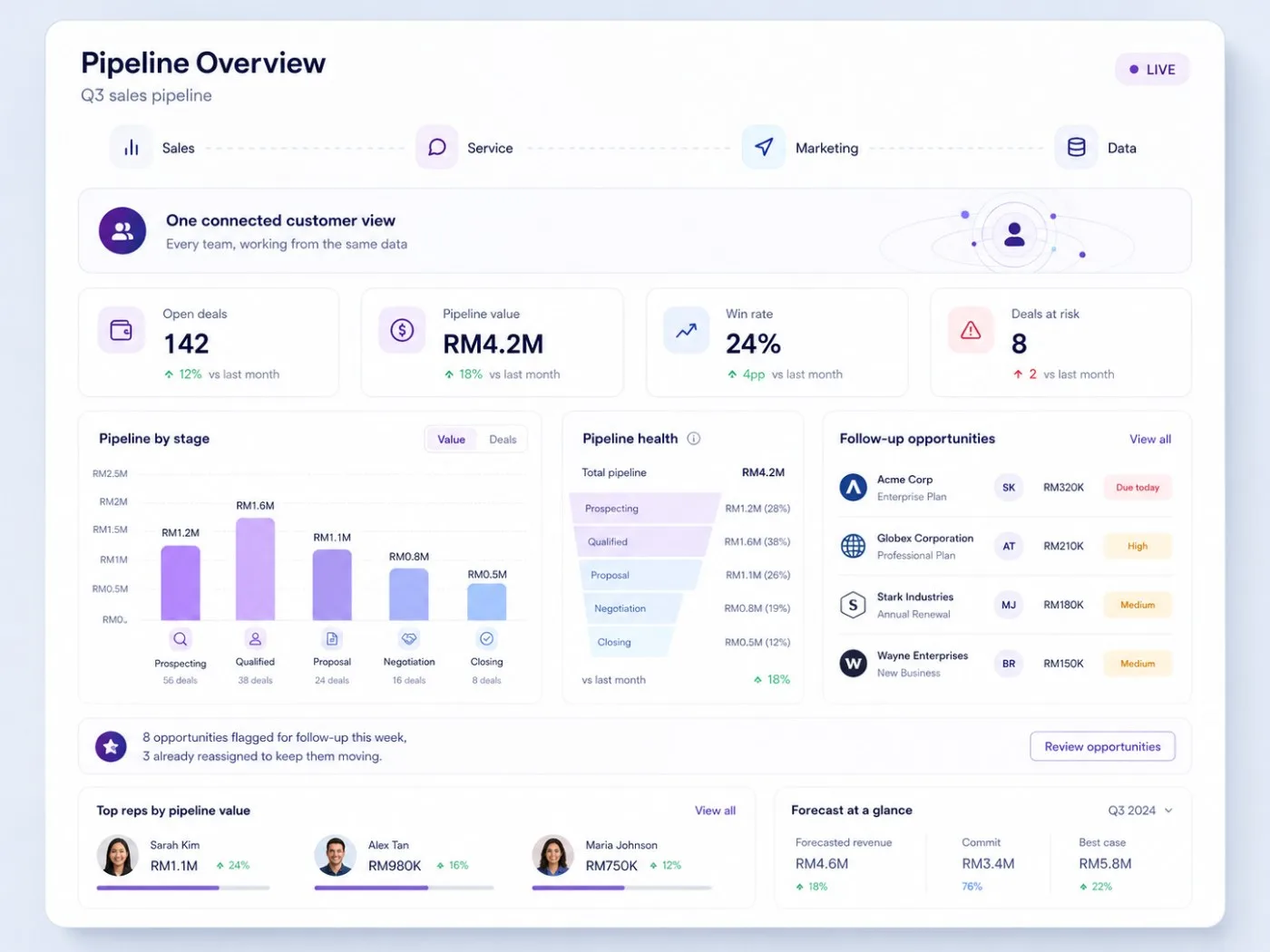
A shared pipeline view across Sales, Service, Marketing, and Data - one record, every team.
The dashboard isn't the point
Ask a sales rep, a support agent, and a marketer at the same company what they know about a given customer, and you'll usually get three different answers. The rep knows the open opportunity. The agent knows about last week's complaint. The marketer knows the customer clicked a promo and nothing since. None of them are wrong - they're just each looking at a fragment.
A Salesforce CRM rollout is often sold on pipeline visibility and forecasting. Useful, but secondary. The change that actually compounds is structural: once sales, service, and marketing read from and write to the same record, every team's next action gets smarter - without anyone doing extra work.
One inbox for every channel a customer actually uses
Customers don't pick one channel and stay there - the same account might email a question on Monday, message on WhatsApp on Wednesday, then call in when it's urgent. When those three conversations live in three separate tools, whoever picks up the call has no idea the email ever happened.
On a unified Salesforce CRM, email threads, WhatsApp messages, and call logs all resolve to the same customer record and timeline. A rep or agent opening an account sees every conversation in order, regardless of channel - so nothing gets answered twice, and nothing falls through the gap between inboxes.
What "fragmented" actually costs
Sales chases a lost cause. A rep pushes an upsell on an account that logged three unresolved support tickets last month - because the CRM and the helpdesk never talk. The deal stalls, and it looks like a sales problem when it's a visibility problem.
Service starts from zero. A customer calls in and has to re-explain who they are, what they bought, and what was already promised - because the case queue has no view of the sales history sitting one system over.
Marketing sends the wrong message. A win-back campaign lands in the inbox of someone who just escalated a complaint, because the segment logic was built on marketing data alone, blind to what service already knows.
What changes once the record is shared
The numbers behind it
This isn't a hypothetical benefit. Organisations that consolidate onto Salesforce Sales and Service Cloud consistently report gains across the same three areas: revenue, productivity, and forecast quality - because each team's work is now informed by the others' data instead of guessing at it.
Where rollouts usually stop short
Most CRM projects get sales set up cleanly, then treat service and marketing as an afterthought - a separate phase, or a separate vendor, bolted on later. The result is a well-configured pipeline tool sitting next to the same old silos it was meant to replace.
The fix isn't more features. It's sequencing the rollout so Sales Cloud and Service Cloud share a data model from day one, with Data Cloud unifying the record underneath - so the "single view" is true on launch day, not a phase-two promise.
Want one customer view across your teams?
We'll help you assess where sales, service, and marketing data are still fragmented - and what it takes to bring them onto one Salesforce CRM.