
Sales Cloud: The Beginning of the CRM Journey
Before service, marketing, or data ever connect to a customer record, that record has to start somewhere. In a Salesforce CRM, it starts with Sales Cloud - the moment a lead first becomes a name your business can act on.
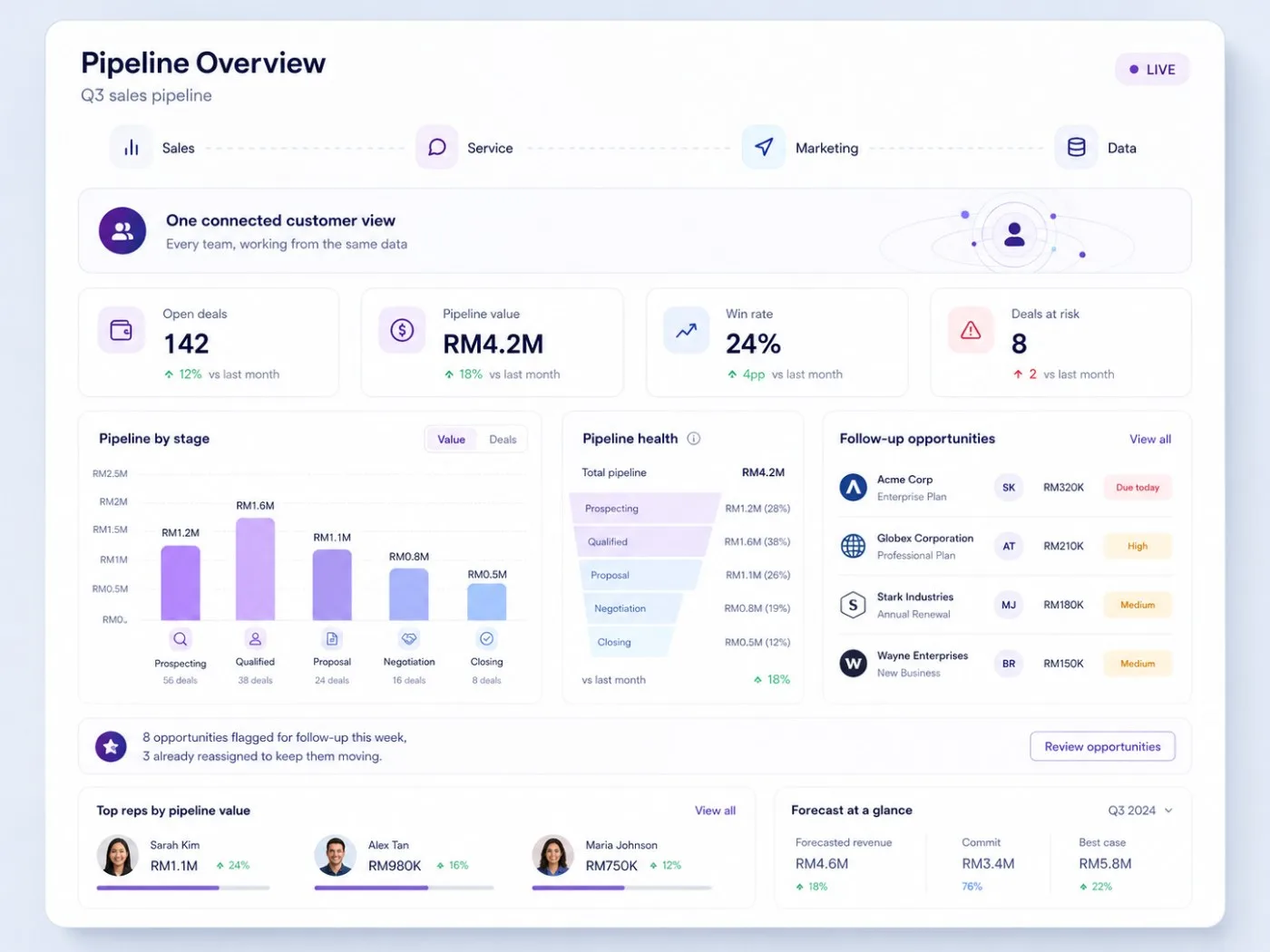
Every deal Sales Cloud tracks becomes the first entry in a customer record other teams will later build on.
Every customer record starts as a lead
Before there's a support case, a marketing segment, or a renewal to forecast, there's just a name - someone who filled in a form, took a call, or got introduced at an event. Sales Cloud is where that name becomes a record: a lead, then a qualified opportunity, then eventually a customer other teams will build on.
That makes Sales Cloud less of a "sales team tool" and more of a foundation. Whatever is captured - or missed - at this stage shapes what service, marketing, and reporting have to work with later.
Lead to opportunity: the first mile
Why the starting point matters more than it seems
A support agent handling a case six months after the sale still benefits from knowing what was promised in the original deal. A marketer building a renewal campaign still needs to know what the account actually bought, and why. None of that is possible if the lead-to-opportunity data was ever loosely captured, duplicated across spreadsheets, or lost when a rep moved on.
Sales Cloud earns its place as the starting point precisely because it's disciplined about that capture - structured stages, mandatory fields, and a pipeline view that makes it obvious when something's missing, rather than letting it slip through informally.
Visibility a rep can act on
Beyond the pipeline stages, what a rep sees day-to-day is what determines whether Sales Cloud gets used properly or worked around. Open deals, pipeline value, win rate, and deals at risk in one view mean a rep can spot a stalling opportunity before it's lost - not after a quarterly review flags it.
That same visibility is what makes forecasting credible further up the chain: leadership isn't reading a rep's optimism, they're reading a pipeline built from consistently captured stages.
The numbers behind it
Getting the beginning of the journey right pays off downstream. Organisations running Salesforce Sales Cloud consistently report gains in revenue, rep productivity, and forecast accuracy - the direct result of a disciplined lead-to-opportunity process rather than an ad hoc one.
The journey doesn't end here
Sales Cloud is the beginning, not the destination. Once a deal closes, that same record needs to keep growing - picked up by service when a case is raised, by marketing when it's time to cross-sell or renew, and by leadership when it's time to forecast the next quarter.
Getting Sales Cloud right on its own is worthwhile. Getting it right as the foundation for a single connected customer view is what turns a good CRM rollout into a genuinely compounding one.
Why a Single Customer View Is the Real Salesforce CRM Win
The biggest CRM payoff isn't a dashboard - it's sales, service, and marketing finally sharing one record.
Read full story → Customer ExperienceWhat Modern CX Really Looks Like with Konnect Insights
After the sale, listening across every channel is how you keep the customer you just won.
Read full story → MarketingHow Marketing Automation Powers an E-Commerce Journey
Mapping browse, cart, checkout and loyalty screens to the triggers running behind them.
Read full story →Ready to build your pipeline on Sales Cloud?
We'll help you set up a lead-to-opportunity process that gives every deal a clean start - and a record the rest of your business can build on.